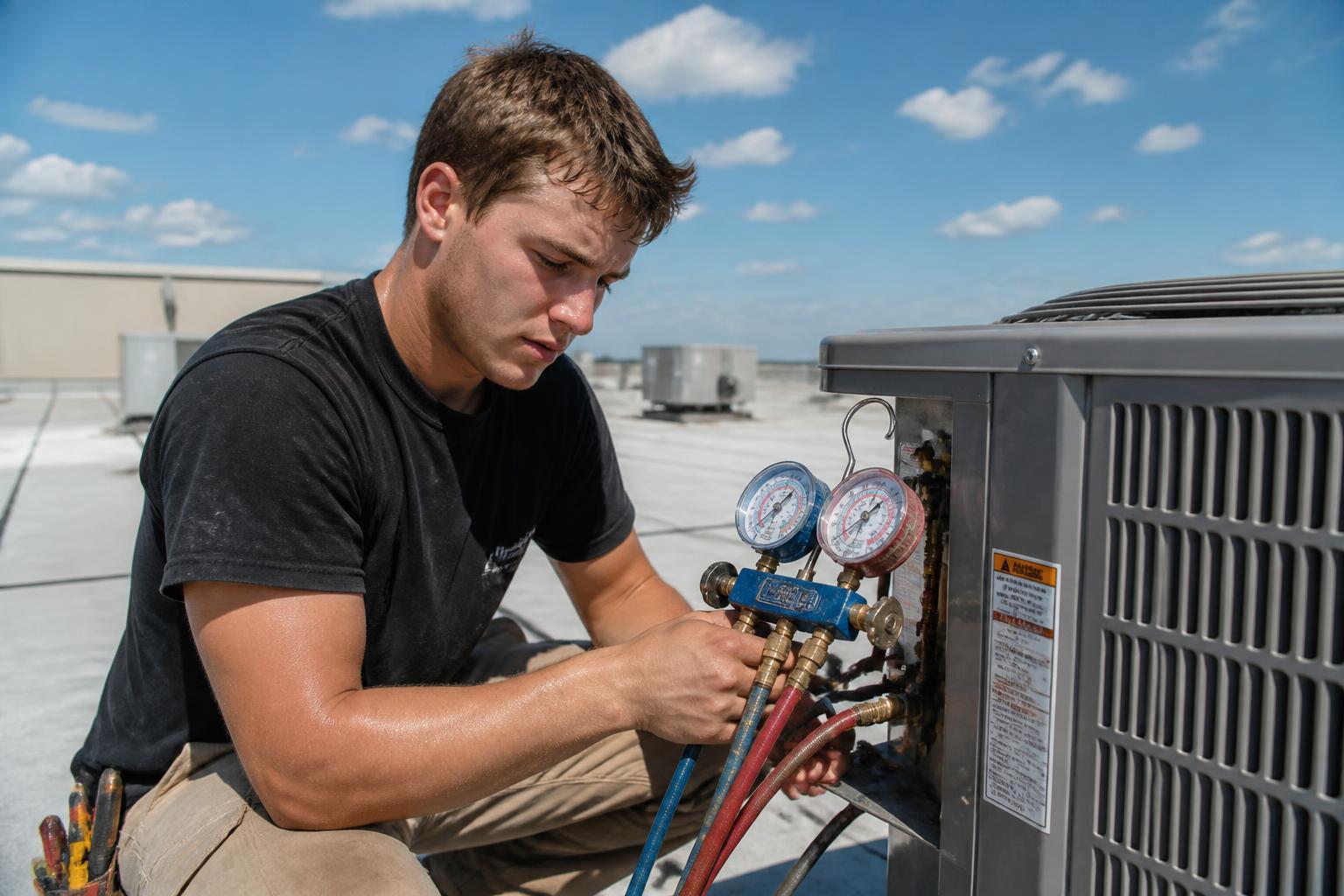
Keeping buildings alive
HVAC & Plumbing
You keep air and water moving through buildings. Some days that's installing a system in a house that's still framed; most days it's finding what failed in a system somebody depends on. You're usually in a truck with your name on the door and a customer waiting.
A day in it
- Dispatch hits my phone before I'm out of the driveway.
- First call is a no-cool. Gauges on, check the charge, check the capacitor.
- Capacitor's swollen. Swap it, system starts, I show the homeowner the old one.
- Second call is a slab leak. That one takes the rest of the morning.
- Lunch in the truck, notes into the tablet between calls.
- Afternoon change-out with another tech, two of us on the condenser.
- Braze the lines, pull a vacuum, charge it, verify the split.
What it pays
- Starting out
- $39,130
- Median
- $59,810
- Experienced
- $91,020
HVACR technicians are SOC 49-9021. Plumbers track separately under SOC 47-2152: $40,670 starting, $62,970 median, $105,150 experienced.
U.S. Bureau of Labor Statistics, Occupational Employment and Wage Statistics, May 2024 (national). Starting out = 10th percentile. Median = 50th. Experienced = 90th. Annual. Georgia figures to be added alongside national. SOC 49-9021. Real numbers only — never estimated, never rounded up.
How you get in
- —Six months to two years of trade school, or a paid apprenticeship.
- —EPA 608 certification is required to touch refrigerant. It's a test, not a degree.
- —Most shops will hire you as a helper first and train you on their trucks.
- —The Mustard Seed covers tuition, the 608 exam, and your first gauge set.
What you need before you start
- —Heat. Attics in a Georgia August are the job, not an exception.
- —A clean driving record — you'll be handed a company truck.
- —You'll talk to customers on their worst day. Patience counts as a skill here.
Someone doing it
Photograph, first name, age, and three or four sentences in their own words — to be supplied.
What it turns into
Lead tech, then service manager, then owner. Home service is the most common trade to end in your own business.
Want to talk to somebody doing this?
Two fields. A person reads it and texts you back.